
Expat Divorce in the UAE — Process, Laws & Custody Guide
Divorce as an expat in the UAE involves unique legal considerations. Since 2022, non-Muslim expats can apply their home country's divorce law through Abu Dhabi's Personal Status Court for Non-Muslims (ADJD) or Dubai's new civil family court. This guide covers the full process, custody rules, and financial settlement options.
Which Law Applies to Your Divorce?
The UAE now offers two legal tracks for divorce:
- Non-Muslim expats: Can apply home country law through Federal Decree-Law No. 41 of 2022 (Civil Personal Status Law)
- Muslim expats: UAE Sharia-based Personal Status Law (Federal Law No. 28 of 2005) applies by default
- Mixed-faith couples: the wife's religion typically determines the applicable law
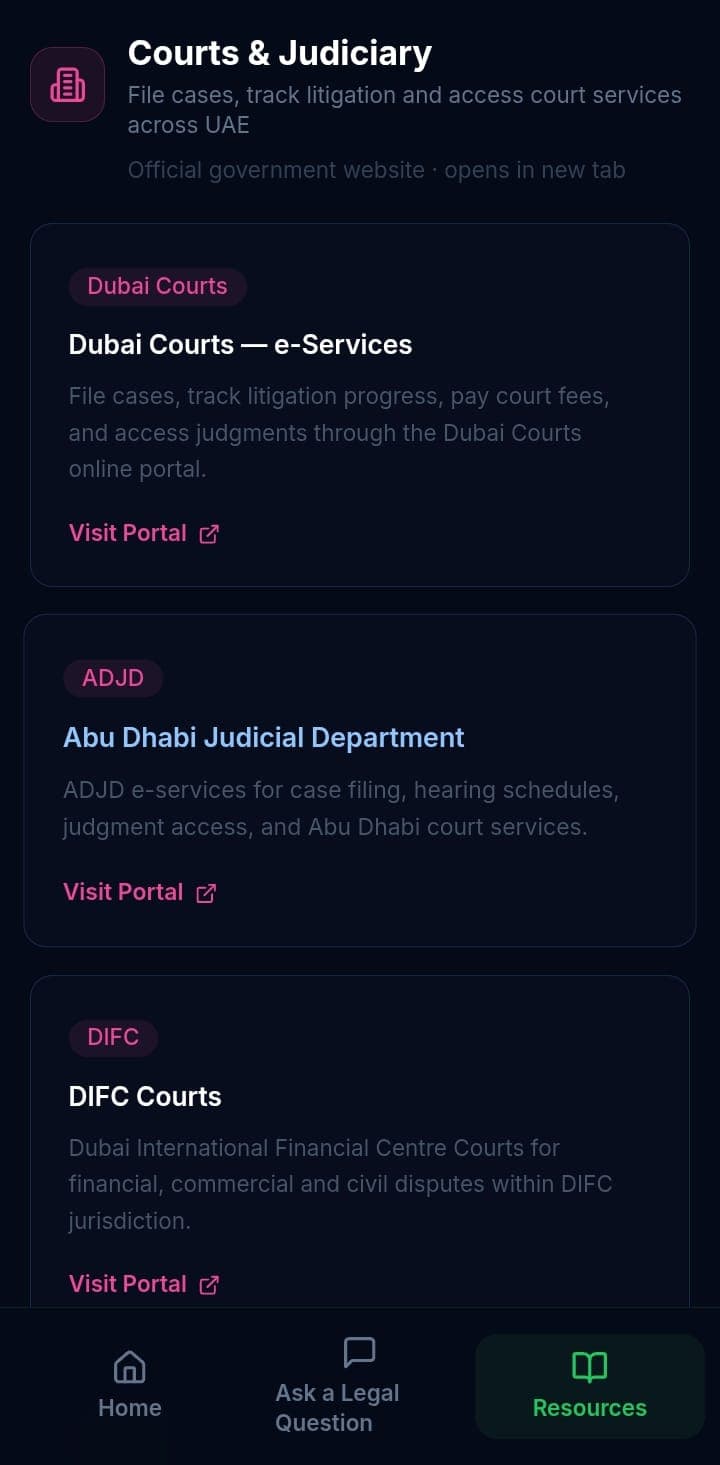
- Abu Dhabi: ADJD Personal Status Court for Non-Muslims handles civil divorces
- Dubai: Family court accepts applications under home country law
- Both parties can agree to apply UAE civil law regardless of nationality
Steps to File for Divorce
The divorce process typically follows these stages:
Child Custody Rules
Custody in the UAE follows the child's best interest principle:
- Under civil law: no automatic preference for either parent
- Under Sharia law: mother typically gets custody until son is 11, daughter is 13
- Court considers: child's age, emotional attachment, parent's ability to provide
- Travel restrictions: custodial parent needs court permission to take children out of UAE
- Visitation rights: non-custodial parent gets defined access schedule
- Both parents retain guardianship (decision-making) regardless of custody
Financial Settlement & Alimony
Financial matters are handled alongside the divorce:
- Alimony (nafaqa): court may order maintenance payments to the lower-earning spouse
- Child support: mandatory until child is financially independent (typically 18–21 years)
- Property division: depends on applicable law — UAE has no community property rule
- Jointly owned property: court can order sale or transfer based on contribution
- Mahr (dowry): if married under Islamic law, remaining mahr becomes due on divorce
- Legal costs: each party typically bears their own costs unless court orders otherwise
Required Documents
Prepare these documents for your divorce application:
- Marriage certificate (attested and translated to Arabic)
- Passports and Emirates ID of both spouses
- Birth certificates of children (if applicable)
- Tenancy contract or proof of residence
- Financial documents (salary certificates, bank statements, property titles)
- Any prenuptial agreement (if exists)
- Court-approved Arabic translation of all foreign-language documents
Need personalised guidance?
Our AI Legal Assistant can answer specific questions about your situation — anonymous and free (5 messages). You can also reach live support if you need human help.
Related Guides
UAE Labour Law: Harassment at Work — Your Rights & Steps
Workplace harassment in the UAE is taken seriously under federal law. Whether you are faci…
Read GuideUAE Tenancy Renewal Rules 2025: Rent Increase, Notice & Your Rights
Understanding tenancy renewal rules in the UAE is critical for both tenants and landlords.…
Read GuideUAE Visa Overstay Fine 2025: Grace Period, Daily Fines & Exit Process
Overstaying your UAE visa carries daily fines and can lead to a travel ban or deportation.…
Read GuideFrequently Asked Questions
Can I get divorced in the UAE if I was married abroad?
Yes — UAE courts have jurisdiction over divorces if either spouse is a resident. You do not need to have married in the UAE. The marriage certificate must be attested and translated.
How long does an expat divorce take in the UAE?
Mutual consent divorces can be completed in 1–3 months. Contested divorces typically take 3–9 months. Mandatory counselling adds 30 days at the start.
Can my spouse prevent me from leaving the UAE during divorce?
A spouse cannot unilaterally impose a travel ban. However, if custody is disputed, the court may issue a travel ban on children. Seek legal advice immediately if you are concerned.
Is my divorce decree valid in my home country?
UAE divorce decrees can be recognised abroad through attestation by the UAE MoFA and your home country's embassy. Some countries require additional court proceedings for recognition.
What if my spouse does not agree to divorce?
UAE courts can grant divorce even without mutual consent. The petitioning spouse must demonstrate valid grounds (harm, desertion, or irretrievable breakdown). The process takes longer but the court will still issue a decree.
Official Resources
Have a specific question about your situation?
Chat with our UAE Legal AI for instant general guidance — anonymous & free.
Chat with AI — 5 Free MessagesGeneral information only. Not a substitute for legal advice from a licensed UAE lawyer.